


Imagine standing on the salt pans of Etosha as a leopard emerges from the shimmering heat haze, its coat a perfect mosaic against the parched earth. You have seconds to lock focus before the ghost of the bush vanishes, yet your equipment hesitates. Selecting the best camera for safari photography 2026 is about more than just technical specifications; it is about finding a rugged companion that translates Namibia's ethereal light into a permanent legacy.
You likely feel the pressure of the "perfect shot" while worrying if your gear can actually survive the fine desert dust or the technical complexity of the Milky Way. It is a common concern for those who seek the profound connection of a premium expedition. This guide will demystify the jargon of sensors and autofocus while showcasing the elite systems that thrive in extreme environments. We will explore how to achieve sharp, evocative wildlife portraits and reliable performance on your next 4x4 photography route, ensuring your memories are as vivid as the landscape itself.
Essential Specs for the African Wild: What Matters in 2026
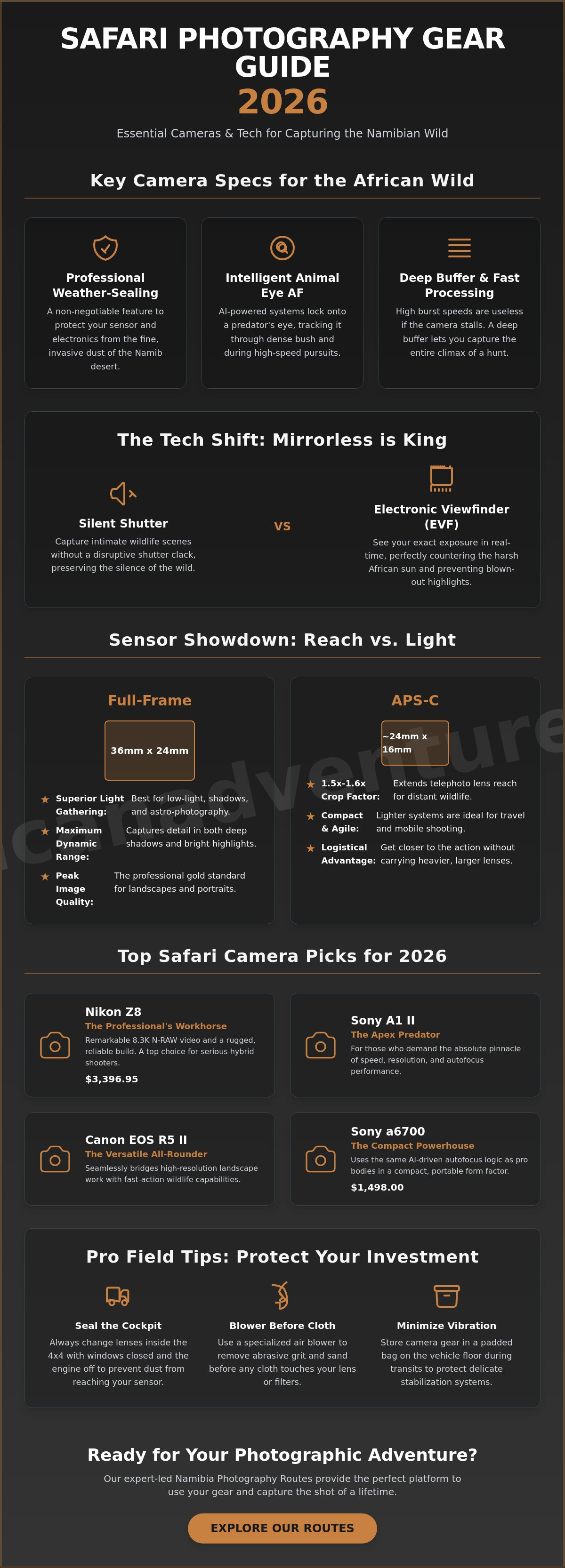
The vast, unforgiving expanses of the Namib require more than just a high megapixel count. To identify the best camera for safari photography 2026, you must prioritize equipment that survives the elements while mastering the light. The fine-grained dust of the desert is pervasive. It finds its way into every unsealed crevice. Professional weather-sealing is a non-negotiable mandate for any serious expedition. Without it, your sensor becomes a magnet for grit, ruining the clarity of your shots and the longevity of your gear.
Intelligent Autofocus has evolved into a sophisticated partner. Modern Animal Eye AF systems in 2026 can now track a predator’s gaze through dense scrub or during a high-speed pursuit. This precision ensures you don't lose the moment to a blurry foreground. Mastering wildlife photography techniques in the bush requires this level of technological reassurance. You also need a deep buffer. High burst speeds are useless if your camera stalls while the hunt reaches its climax. A camera that processes data effortlessly allows you to stay present in the unfolding drama without technical anxiety.
Mirrorless Dominance: Why the DSLR Era has Ended
The shift to mirrorless is absolute. Silent shutters allow you to capture an intimate moment with a desert-adapted lion without the intrusive clack of a mirror. It preserves the sacred silence of the wild. Electronic Viewfinders (EVF) are equally vital. They show your exact exposure in real-time. This is essential when the harsh African sun threatens to wash out the rich textures and deep oranges of the dunes.
Full-Frame vs. APS-C: Reach vs. Light
Choosing between sensor sizes is a balance of priorities. APS-C sensors offer a significant "crop factor" advantage, effectively extending the reach of your telephoto lenses for shy or distant wildlife. It's a logistical win for travelers who value agility. However, full-frame sensors remain the gold standard for the deep shadows of Sossusvlei and the brilliance of the Milky Way. They offer the superior dynamic range and low-light performance needed to capture Namibia’s high-contrast landscapes with professional precision.
The Top Safari Cameras of 2026: Expert Recommendations
Choosing the best camera for safari photography 2026 requires a balance between raw technical power and the practicalities of a rugged expedition. The Nikon Z8 has emerged as a formidable choice for professionals this year. It is currently available at a discounted price of $3,396.95. This system offers remarkable 8.3K N-RAW video capabilities. The Sony A1 II remains a titan for those who demand the highest resolution paired with unmatched speed. These flagship systems represent the pinnacle of reliability. They are essential when tracking a cheetah across the Kalahari or a desert-adapted elephant in a dry riverbed.
For enthusiasts who seek a versatile all-rounder, the Canon EOS R5 II provides a seamless bridge between high-resolution landscape work and fast-action wildlife. If portability is your primary concern, the Sony a6700 is a compact powerhouse priced at $1,498. It utilizes the same AI-driven autofocus logic found in much larger professional bodies. This makes it an ideal companion for our Namibia Photography and Adventure Routes where every piece of gear must earn its place in the 4x4. Hybrid capabilities are no longer a luxury. High-quality 8K video is now a standard requirement for documenting the transformative nature of the journey.
Top Picks for Wildlife and Action
Success in the bush often hinges on subject recognition. The 2026 flagship releases utilize deep-learning AI to predict animal movement before it happens. This technology ensures your focus stays locked on the eye of a predator even through thick acacia branches. Pairing these bodies with the right telephoto glass is critical. You might consider a 400mm or 600mm lens to maintain a respectful distance. Reviewing a professional introduction to wildlife photography will help you understand how to balance these focal lengths with the unique light of the Southern Hemisphere.
Best Options for Landscapes and Astro-Photography
Namibia's vastness demands incredible detail. High-resolution sensors exceeding 45 megapixels are necessary to capture the intricate, rust-colored textures of Damaraland and the sharp clarity of the Milky Way. Advanced in-body image stabilization allows you to capture crisp, evocative handheld shots as the sun dips below the horizon. It ensures your landscape captures remain sharp even when a tripod is not practical.
Maximizing Your Gear: Fieldcraft on a Premium Expedition
Even the best camera for safari photography 2026 is only as effective as the fieldcraft behind it. In the heart of the Namib, the environment is as beautiful as it is brutal. Fine-grained sand is a constant, invasive presence. It settles on every surface. To protect your sensor, avoid lens changes in the open air. Perform these transitions inside the 4x4 with the windows closed and the engine off. Use a specialized blower to remove grit before any cloth touches your glass. It’s a methodical practice that ensures your equipment remains as pristine as the landscapes you are capturing.
Our best guided overlanding routes Namibia offer more than just a path; they provide the stable, elevated platform essential for sharp wildlife captures. However, the rugged terrain can be punishing. Vibration is a silent enemy of delicate internal stabilization systems. Always store your gear in a padded bag on the vehicle floor during transits to minimize bounce. This simple logistical certainty protects your investment while crossing ancient riverbeds or rocky plateaus. Timing remains the ultimate specification. The golden hour in Namibia is a short, transformative window where the light turns to liquid gold. You must be ready before it arrives.
The Guide as Your Photography Assistant
A seasoned guide is an extension of your creative process. They possess a deep local expertise that allows them to anticipate animal behavior before the action starts. By reading the subtle cues of the bush, they position the vehicle to ensure the sun is at your back or perfectly placed for rim-lighting on a desert lion. This professional reassurance allows you to stay present in the moment. It removes the frantic energy of guessing where the next shot might be.
Post-Processing in the Bush
The journey continues after the sun dips below the horizon. Our guided namibia tours take you to remote, uncrowded locations where the stars offer a second act for your lens. Ensure your workflow is as rugged as your 4x4. Use high-speed portable SSDs to back up your files every evening. With the latest software like Adobe Lightroom Classic version 15.3, you can begin organizing your legacy while the campfire crackles. This disciplined approach ensures that even the best camera for safari photography 2026 is backed by a secure and organized digital archive.
Capture Your Namibian Legacy with Professional Precision
The journey to capturing Namibia's raw beauty begins with selecting the best camera for safari photography 2026, but it truly culminates in the field. We've explored how intelligent autofocus and weather-sealed bodies provide the technical foundation needed to survive the desert. However, the most evocative images depend on being in the right place at the perfect moment of light. Success requires a balance of high-end technology and the seasoned intuition of an expert guide who understands the rhythm of the bush.
Ready to put your gear to the test? Book Your Premium Photography Expedition with My African Adventures. Our fully serviced 4x4 expeditions are specifically designed for wildlife viewing. We offer exclusive access to remote landscapes that remain untouched by mass tourism. You'll be led by professional photography enthusiasts who know exactly how to position the vehicle for that once-in-a-lifetime shot. Don't just witness the wild. Capture its soul. Your African adventure is waiting to be told through your lens.
Frequently Asked Questions
Is a mirrorless camera better than a DSLR for a 2026 safari?
Mirrorless systems are the superior choice for a 2026 safari because they offer silent electronic shutters and advanced AI subject tracking. In the quiet of the Namib, the mechanical clack of a DSLR mirror can startle shy wildlife. Mirrorless bodies also provide real-time exposure previews in the viewfinder. This is vital when managing the high-contrast light of the desert. The transition is absolute.
What is the best lens focal length for wildlife photography in Namibia?
A versatile zoom lens like a 100-400mm or 200-600mm is ideal for capturing distant predators while maintaining a respectful distance. For the best camera for safari photography 2026, pairing a high-resolution body with a telephoto lens allows you to crop into the frame without losing detail. Don't forget a wide-angle lens. A 16-35mm is perfect to capture the immense scale of the Sossusvlei dunes.
How do I protect my camera gear from dust in the Namib Desert?
Protection begins with professional weather-sealing and a disciplined fieldcraft routine. Keep your equipment in a dust-proof dry bag when the vehicle is in motion and only perform lens changes inside the cabin. Using a protective UV filter can also prevent the abrasive Namib sand from scratching your expensive front lens elements during a sudden gust of wind. It's about being methodical.
Do I need a tripod for a guided 4x4 overlanding tour?
You don't usually need a tripod for wildlife shots from the vehicle, as beanbags or modern in-body stabilization are more practical. However, a sturdy tripod is essential for capturing the crisp brilliance of the Milky Way during our premium stargazing adventures. It provides the necessary stability for the long exposures required to document Namibia's internationally recognized dark skies. Precision requires a solid base.