


What if the most profound silence you ever hear is found along a desert track, hundreds of miles from the nearest paved road? For many, the dream of a kaokoland expedition represents the ultimate African frontier, yet the anxiety of mechanical failure or navigating remote terrain often keeps the dream out of reach. It's a land where the Kunene River carves a silver ribbon through ancient dust, demanding both deep respect and meticulous preparation. You shouldn't have to choose between the thrill of the wild and the certainty of professional support.
We believe that true exploration is most powerful when you're free to focus on the horizon rather than the logistics. This guide reveals how to traverse Namibia’s last true wilderness with a sophisticated balance of raw adventure and refined comfort. You'll learn how to navigate the 2026 park fee increases and new visa requirements while ensuring your journey remains a curated masterpiece of high-end photography and respectful cultural connection. From the Skeleton Coast to the Himba heartlands, discover how a fully serviced trek transforms a daunting challenge into a seamless, life-changing odyssey.
Key Takeaways
- Understand why a kaokoland expedition represents Africa's final frontier, offering a depth of isolation that traditional lodge safaris cannot match.
- Learn the benefits of a fully serviced overlanding model where expert guides handle the technicalities of Van Zyl’s Pass while you focus on the landscape.
- Gain insights into respectful cultural encounters with the semi-nomadic Himba and the best practices for tracking rare desert-adapted elephants.
- Identify the optimal conditions for capturing the unique, dust-filtered light of the Baynes Mountains for professional-grade photography.
- Explore why private small-group expeditions are the superior choice for those seeking a tailored pace and intimate bonding with friends or family.
What Defines a True Kaokoland Expedition?
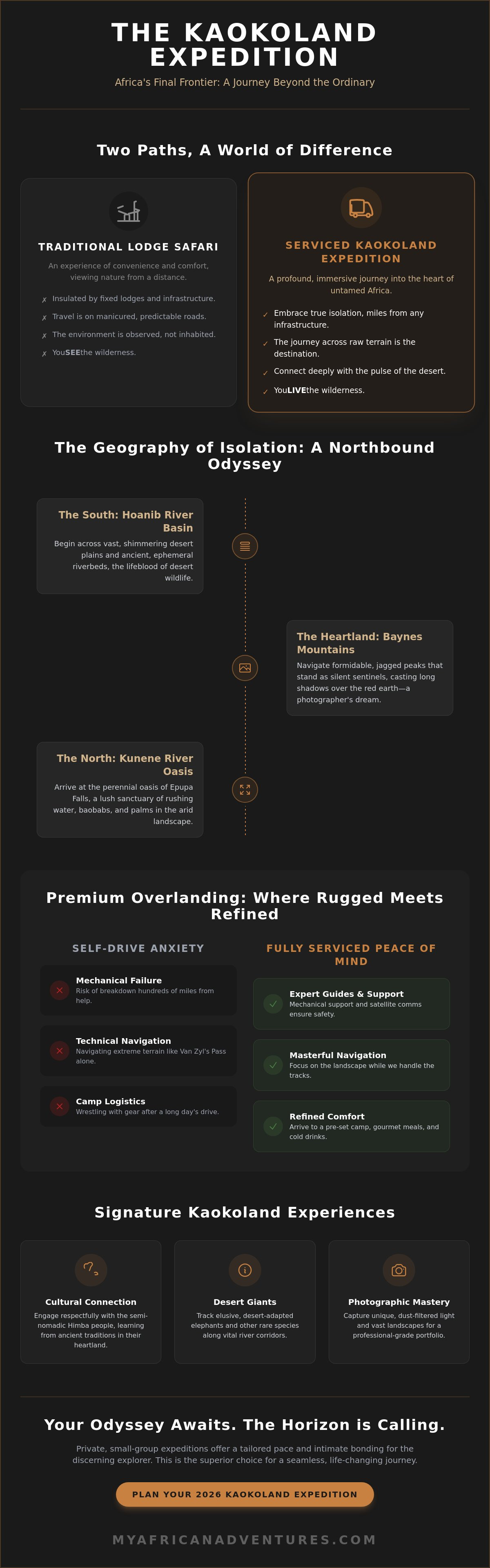
To understand the essence of a kaokoland expedition, one must first accept that this is not a traditional safari. While many Namibian journeys focus on the convenience of fixed lodges and manicured gravel roads, this region offers something far more visceral. Situated in the far north-western corner of the country, it's a landscape defined by its defiance of modern infrastructure. It's a place where the map often feels like a suggestion rather than a rule. Here, the journey is the destination, and the ability to remain self-sufficient in the face of absolute isolation is what separates a mere tourist from a true explorer.
A genuine expedition traverses the vast expanse between the ephemeral Hoanib River and the permanent, rushing waters of the Kunene. It's an exercise in rhythmic travel across ancient riverbeds and over jagged mountain passes. Unlike lodge-based stays that insulate you from the environment, overlanding places you directly within the heartbeat of the desert. You don't just see the wilderness; you live within its shifting temperatures and textured winds. It's a curated logistical masterpiece that requires expert navigation, ensuring that while the surroundings are raw, the experience remains one of professional luxury.
The Geography of Isolation
The terrain of Kaokoland is a dramatic study in contrast. The journey typically begins in the south, where wide, shimmering desert plains eventually give way to the formidable Baynes Mountains. These peaks stand as silent sentinels over the valley floor, their shadows stretching across the red earth as the sun dips. Life here is dictated by water. Ephemeral systems like the Hoanib and Hoarusib provide vital corridors for wildlife, their dry beds hiding underground reserves that sustain desert-adapted species. As you move north, the arid heat is eventually broken by the perennial oasis of the Kunene River. At Epupa Falls, the water tumbles over ancient rocks, surrounded by baobabs and palms, creating a lush sanctuary that feels almost impossible given the surrounding dust.
The Allure of the Edge
There's a psychological weight to the silence found at the edge of the world. In Kaokoland, the horizons are so vast that they challenge your perception of scale. This is modern-day exploration for the discerning traveler who seeks more than just a photograph. It's about the transformation that occurs when you disconnect from the digital hum and reconnect with the earth's natural frequency. For those planning a 2026 departure, the seasonal conditions following the early-year rains offer the most striking visual contrasts. The desert blooms briefly, and the dust-filtered light becomes a photographer’s dream. It's a window of time where the rugged tracks are most inviting, provided you have the logistical competence of a seasoned team to guide the way.
The Logistics of Premium Overlanding: Rugged Comfort
Choosing a kaokoland expedition doesn't mean sacrificing the finer things in life. While the terrain is notoriously unforgiving, the logistical framework of a premium journey ensures that every challenge is met with professional ease. In this fully serviced model, the heavy lifting of camp life disappears. You won't find yourself wrestling with heavy canvas or struggling to light a fire after a long day behind the wheel. Instead, our team handles the complex choreography of the bush, allowing you to remain entirely present in the moment.
Technical mastery is a prerequisite for this landscape. Navigating the legendary Van Zyl’s Pass or the deep, shifting sands of the Hoarusib riverbeds requires a high-clearance 4x4 vehicle and, more importantly, the skill to use it. Many travelers underestimate the sheer mechanical toll of these tracks. By opting for a guided journey, you bypass the anxiety of potential breakdowns in regions where cell service is non-existent. We provide the mechanical support and satellite communication necessary to ensure that even the most remote corners of Namibia are explored with total peace of mind.
The comfort myth is easily dispelled at the first sunset. Imagine stepping out of your vehicle to find a pre-set camp where crisp linens and a cold gin and tonic await. Gourmet meals are prepared over open flames, proving that desert dining can be a sophisticated culinary experience. It's a level of curation that turns a rugged trek into a fully serviced 4x4 camping adventure that feels both intimate and exclusive.
A Day in the Life of a Serviced Expedition
Your morning begins with the scent of fresh coffee and the crackle of a small fire as the desert wakes up in shades of violet and gold. The rhythm of travel is deliberate, balancing focused drive times with immersive stops to track wildlife or explore geological oddities. There is no rush. The true magic happens at the end of the day when you arrive at a new, secluded location to find your private camp already established, allowing you to transition straight from the dust of the road to the comfort of a prepared sanctuary.
Beyond Self-Drive: The Value of Expertise
Self-driving in Kaokoland is a high-risk endeavor for the inexperienced. Beyond the mechanical dangers, there is the risk of missing the very things you came to see. A professional guide doesn't just navigate; they interpret the landscape. They find the "invisible" tracks that lead to hidden desert springs or ancient rock art that a GPS would never reveal. In these "black zones," having a seasoned guardian who understands the local nuances and maintains constant safety protocols is the difference between a stressful ordeal and a transformative journey.
The Heart of the Journey: Desert Giants and Ancient Cultures
A kaokoland expedition is defined by moments of profound connection that feel entirely unscripted. In this vast, open system, wildlife doesn't congregate around man-made waterholes or wait by the roadside for a photograph. Instead, life is elusive. It requires patience, a keen eye, and a deep understanding of the desert's subtle cues. When you finally encounter a herd of elephants moving through a dry riverbed, the experience isn't a mere attraction. It's a rare privilege that underscores the resilience of life in one of the world's most demanding environments.
This sense of reverence extends to the people who have called this arid frontier home for centuries. The Himba represent a living testament to cultural resilience, maintaining a semi-nomadic lifestyle that has remained largely unchanged by the outside world. Engaging with these communities isn't about ticking a box on a sightseeing list. It's about a quiet, respectful exchange facilitated by those who understand the delicate social fabric of the region. We prioritize authentic encounters that honor the dignity of the "Red People" while ensuring our presence supports their local conservancies through a thoughtful, private approach.
Tracking the Desert-Adapted Elephant
These specialized giants are a marvel of biological adaptation. While they are the same species as their savanna cousins, desert elephants have evolved smaller body masses and proportionally larger feet to navigate the soft sands of the Hoanib. They're capable of traveling up to 70 kilometers in a single day in search of water, often going several days without a drink. Tracking them through the silt and scrub is a masterclass in bushcraft. These elephants act as vital ecological engineers; they dig for water in dry riverbeds, creating life-saving wells that sustain countless other species in the arid Kunene region.
Respectful Immersion with the Himba
Authentic cultural tourism requires more than just a camera and a 4x4. It demands an understanding of traditional etiquette and local language skills that only a seasoned guide can provide. Our approach moves away from colonial tropes, focusing instead on non-intrusive immersion. We don't just visit villages. We enter as guests. By following proper protocols and engaging through a translator who knows the families personally, we foster a space for genuine connection. It's a chance to learn about their intricate social structures and the significance of the sacred fire, known as the okuruwo, without disrupting the rhythm of their daily lives.
The Visual Narrative: Photography and the Namibian Night
The light in the far north doesn't just illuminate the landscape; it defines it. During a kaokoland expedition, the golden hour takes on a surreal, almost liquid quality. This is due to the fine, microscopic dust particles suspended in the air, which scatter the sun's rays into a spectrum of deep ambers and soft violets. It's a photographer's dream. The dramatic textures of the Baynes Mountains provide a rugged backdrop, while the clay castles of the Hoarusib River offer intricate, melting shapes that change with every passing minute of the sun's descent. Capturing these moments requires more than just technical skill; it requires being in the right place at the precise moment the shadows begin to stretch.
Professional guidance is the secret weapon of any serious photographer in this terrain. A seasoned guide understands the geometry of the desert. They'll ensure the vehicle is positioned perfectly to catch the first light hitting a mountain ridge or lead you to a hidden vantage point where the riverbed is backlit by the rising sun. It's this level of expert curation that transforms a standard trip into a premier Namibia desert, wildlife and photography route, where every stop is calculated for its visual impact and emotional resonance.
Capturing the Textures of the Desert
Success in Kaokoland photography often comes down to managing the extreme contrasts of the environment. The deep red ochre of the earth against a piercingly blue Namibian sky creates a vibrant palette, but it can be challenging for digital sensors. We recommend a versatile zoom lens, such as a 24-105mm, to minimize lens changes in the dusty environment. This allows you to capture wide-angle vistas of the mountain ranges and then quickly punch in on the "Stonemen" of Kaokoland. These mysterious stone sculptures, placed by an anonymous artist across the region, serve as hauntingly beautiful subjects that anchor the vastness of the desert in a human narrative.
Astro-Photography: The Milky Way at 20 Degrees South
Kaokoland remains one of the darkest places on Earth, free from the encroaching glow of urban light pollution. At approximately 20 degrees south, the galactic center of the Milky Way passes nearly overhead during the Namibian winter. This creates a celestial canopy so bright it can cast a shadow on the desert floor. To capture the ultimate star-gazing experience in 2026, photographers should target the weeks surrounding the new moons on June 15 or July 14. These dates offer the absolute darkness required for long-exposure shots. Imagine the ancient, gnarled silhouettes of baobab trees framed by the shimmering dust of a billion stars, a scene that feels as old as the earth itself. Using a tripod and a wide-aperture lens, you can document a night sky that most people will never witness in their lifetime.
Why a Private Small-Group Expedition is the Logical Choice
Choosing a kaokoland expedition is more than a travel decision; it's an investment in a shared legacy. In a world that's increasingly connected yet emotionally distant, the vastness of northern Namibia offers a rare sanctuary for meaningful connection. While larger, scheduled tours often move with a rigid, impersonal momentum, a private small-group setting allows the desert to dictate the pace. It's the difference between seeing a landscape and truly absorbing its soul. Whether you're traveling with family or a close-knit circle of friends, the privacy of the journey ensures that the only voices you hear are those that matter most.
This flexibility is the ultimate luxury in a wilderness this unpredictable. If a particular valley captures your imagination or a rare wildlife sighting demands another hour of quiet observation, a private itinerary pivots with you. You aren't beholden to a stranger's schedule or a fleet manager's checklist. Our philosophy at My African Adventures is built upon this foundation of intimacy, quality, and uncompromising safety. We handle the complexities of the track so that your only responsibility is to remain present in the unfolding narrative of the wild.
Tailored for Connection: Father-and-Son or Friends
Shared adventures in the deep desert have a unique way of forging lifelong memories. There's a specific kind of camaraderie that grows from navigating a challenging mountain pass or sharing a meal under a canopy of stars. By removing the burden of camp chores and logistical planning, we create a space where you can focus entirely on the experience and each other. It's about the stories told over the fire and the shared silence of a desert sunrise. This level of curated exclusivity is why private small-group Namibia expeditions are better for those who seek depth over distance.
Securing Your 2026 Expedition
The logistics of a premium journey into Namibia's most remote frontier are intricate and demand significant lead times. For 2026 departures, securing the most seasoned guides and specialized 4x4 vehicles requires early planning, often twelve to eighteen months in advance. This is especially true if you wish to align your journey with specific seasonal windows, such as the clear-sky months of June and July or the brief, vibrant bloom following the early rains. Booking early isn't just about availability; it's about the meticulous preparation required to ensure your expedition is a seamless masterpiece of exploration.
The true transformation of a journey to the Kunene happens when the digital hum of the modern world finally falls away. In that profound silence, you find a version of yourself that is both humbled and inspired. It's a rare gift to witness a landscape so untouched and a culture so resilient. When you're ready to step beyond the known, plan your private Kaokoland expedition with My African Adventures. Let us guide you into the heart of the silence.
Embrace the Call of the Far North
The journey across Namibia’s most remote frontier is a rare opportunity to witness a world that remains largely indifferent to the passage of time. We've seen how a kaokoland expedition transforms from a logistical challenge into a curated masterpiece when the right expertise is at the helm. From tracking the specialized giants of the Hoanib to capturing the celestial dance of the Milky Way, these moments define a life well-traveled. You don't have to sacrifice comfort to reach the edge of the map.
Our team provides the exclusive access and technical mastery required to navigate these trackless regions with total peace of mind. By choosing a fully serviced 4x4 camping adventure, you eliminate the stress of setup and chores, allowing the desert’s profound silence to take center stage. Every route is expert-led by professional photography and wildlife guides who are dedicated to your personal growth and safety. Begin your Kaokoland journey with our expert guides and discover the power of Africa’s last true wilderness. The horizon is waiting for you.
Frequently Asked Questions
What is the best time of year for a Kaokoland expedition?
The optimal window for a kaokoland expedition is the dry winter season, spanning from May to September. During these months, the daytime temperatures are pleasantly mild and the skies remain exceptionally clear for photography. Nighttime can be crisp, but you'll avoid the intense heat and flash flooding risks associated with the summer rains. This period also offers the best conditions for tracking wildlife as they congregate near known water sources.
Do I need previous 4x4 experience to join a guided Kaokoland tour?
You don't need any previous off-road experience to join our guided journeys. Our professional guides handle all the technical driving and navigation through challenging terrain like Van Zyl’s Pass. If you choose a private expedition where you are the passenger, you can simply relax and absorb the scenery. For those in a guided convoy, your lead guide provides constant radio support and instruction to ensure you navigate every obstacle safely.
Is it safe to visit Himba villages in the Kunene region?
Visiting Himba villages is entirely safe and deeply rewarding when conducted through a professional guide who understands local etiquette. These encounters are based on mutual respect and established relationships rather than intrusive tourism. Your guide acts as a cultural bridge, ensuring that all protocols are followed and that your presence supports the community’s conservancy efforts. It's an intimate opportunity to learn about a resilient way of life in a dignified setting.
What should I pack for a premium camping trip in Namibia?
Packing for the desert requires a strategy of layers to manage the significant temperature shifts between noon and midnight. Include lightweight, breathable clothing for the day and a high-quality jacket for the cool evenings. Sturdy, closed-toe walking boots are essential for the rocky terrain. Don't forget a wide-brimmed hat, high SPF sunscreen, and specialized dust protection covers for your camera equipment to guard against the fine Namibian silt.
Are there desert lions in the Kaokoland?
Desert-adapted lions do inhabit the Kaokoland, though they are notoriously elusive and cover vast territories. These lions have specialized behaviors that allow them to survive in the hyper-arid coastal and mountain regions. While sightings are never guaranteed in such a massive, unfenced wilderness, our guides use their deep local knowledge to track these magnificent predators. Encountering a desert lion in the wild is a rare and profound privilege that few travelers ever experience.
How long does a typical Kaokoland expedition take?
A typical kaokoland expedition requires between 10 and 14 days to fully appreciate the region's scale and diversity. This duration allows for a methodical pace, ensuring you have enough time to explore the riverbeds, visit remote communities, and reach the Kunene River without feeling rushed. Shorter trips are possible but often miss the deeper sense of isolation and transformation that defines this northern frontier. It's a journey meant to be savored rather than hurried.
What is the difference between a self-drive and a guided expedition?
The primary difference lies in safety and the level of service provided. A guided expedition includes a professional team that manages all logistics, mechanical support, and gourmet catering, leaving you free to explore. Self-driving in this region is high-risk due to the lack of cell coverage and technical tracks. Our fully serviced model ensures you have a seasoned guardian to handle the complexities of the bush while you enjoy refined comfort and expert insight.
Can I charge my camera gear during the mobile camping safari?
You can certainly charge your camera gear and mobile devices during the safari. Our expedition vehicles are equipped with high-quality inverters and charging stations designed to handle professional equipment. We also utilize portable power solutions at our camps to ensure a steady supply for your batteries and laptops. You won't have to worry about missing a shot of the Baynes Mountains or the Namibian night sky due to a dead battery.