


The most breathtaking photograph of the Namib Desert isn't a result of the camera you carry, but the logistical precision that places you on a 300-meter dune exactly four minutes before sunrise. You likely understand that capturing a world-class frame in one of the world's most sparsely populated countries requires more than just a keen eye. It demands a constant battle against fine silica dust, searing heat, and the complex dance of desert shadows. Planning the ultimate namibia photography expedition means moving beyond the limitations of budget travel to embrace a journey where every detail is curated for the lens.
We've designed this masterclass to ensure you never miss a golden hour or risk a gear failure in the dunes. You'll learn how to navigate the 2026 permit requirements, master the timing for world-class astrophotography, and access the skeletal beauty of Deadvlei without the typical crowds. This guide covers everything from essential heat-resistant gear to the secret schedules of the Skeleton Coast. It provides the roadmap for a seamless, deep-immersion experience that transforms your portfolio and your perspective on the wild.
Planning Your Vision: Timing, Moon Phases, and the Desert Light
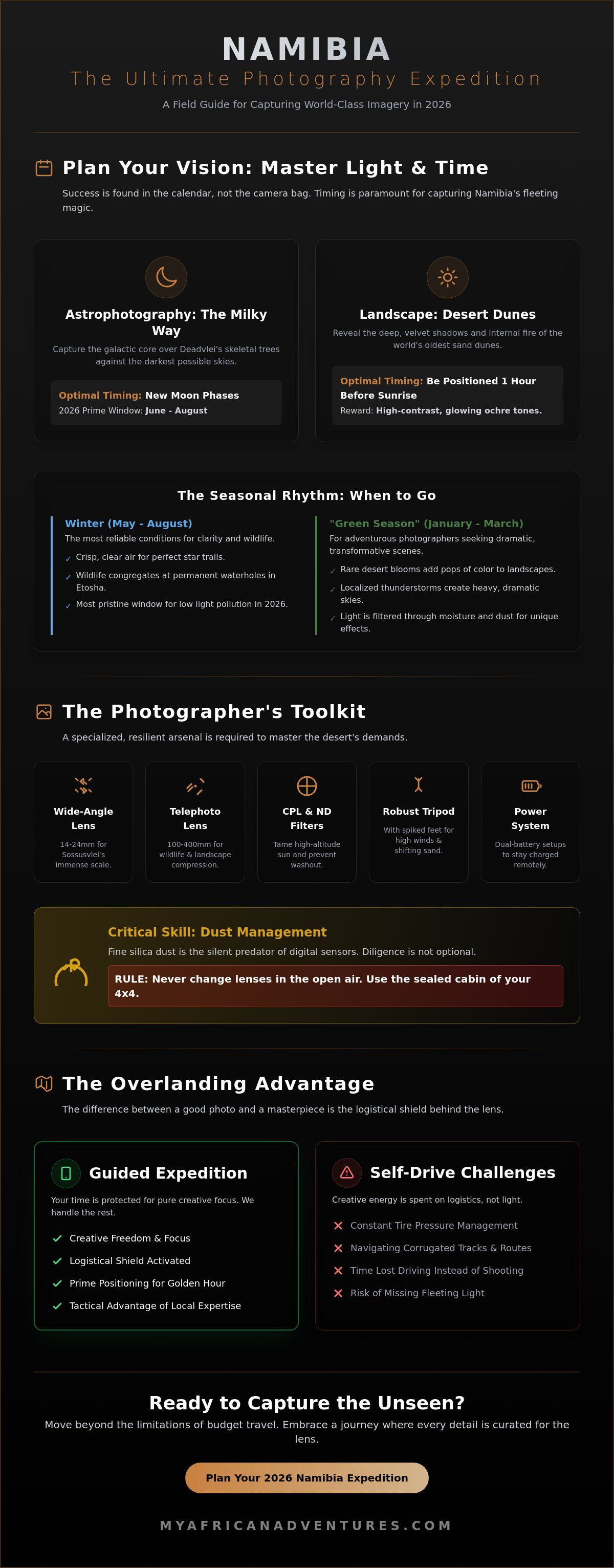
Success on an ultimate namibia photography expedition isn't found in the camera bag; it's found in the calendar. For 2026, the celestial alignment is particularly striking. To capture the Milky Way arching over the skeletal trees of Deadvlei, you must align your arrival with the new moon phases. This ensures the darkest possible skies, free from lunar wash. The vast, empty expanses of Namibia's diverse geography provide a canvas where light behaves differently than anywhere else on earth. It's a place where the atmosphere is so thin and dry that the stars feel close enough to touch.
Desert light is notoriously fleeting. The transition from the soft, pastel hues of pre-dawn to the harsh, vertical sun happens in a heartbeat. You need to be in position at least an hour before the sun breaks the horizon. This is when the dunes reveal their deep, velvet shadows and the red sand glows with an internal fire. It's a high-contrast environment that rewards those who understand the nuance of timing. Balancing the predator activity in Etosha with the shifting sands of the south requires a methodical approach to your itinerary. While the north offers raw wildlife drama, the south provides the geometric perfection of the dunes.
Don't overlook the shoulder seasons. While many photographers flock to the dry winter, the transition months offer dramatic cloud formations that add scale and movement to landscape shots. These clouds catch the fading light, turning the sky into a bruised palette of purple and gold. It's a sophisticated dance between patience and preparation.
The Seasonal Rhythm: When to Capture Namibia’s Best
Winter (May-August)
These months offer the most reliable conditions for an ultimate namibia photography expedition. The air is crisp and clear, providing the perfect transparency for long-exposure star trails. Wildlife congregates at permanent waterholes in Etosha, making it easier to frame lions and elephants against the stark, white salt pan. The most pristine window for low light pollution in 2026 falls during the winter new moon cycles, specifically between June and August.
The "Green Season" (January-March)
For the adventurous, the early months of the year bring rare desert blooms and localized thunderstorms. These storms create heavy, dramatic skies that contrast beautifully against the orange dunes. It’s a time of transformation where the desert feels alive and the light is filtered through moisture and dust.
The Photographer’s Toolkit: Essential Gear and Technical Mastery
Equipping yourself for an ultimate namibia photography expedition requires a shift from standard travel kits to a more specialized, resilient arsenal. The "Namibian Standard" typically revolves around two primary focal ranges. A 14-24mm wide-angle lens is indispensable for capturing the sheer scale of the Sossusvlei dunes, while a 100-400mm telephoto lens allows you to compress the desert's ridgelines and safely frame Etosha’s predators. You'll also need high-quality circular polarizers and neutral density filters to tame the high-altitude sun, which can easily wash out the rich ochre tones of the sand if left unmanaged.
Stability is your next priority. In the high-wind environments of the central plateaus, a lightweight travel tripod often fails to hold steady. You need a robust set with spiked feet to anchor into the shifting grains. While the country is a welcoming destination, staying informed via the U.S. State Department travel advisory ensures you're prepared for local road conditions and safety protocols. Power management is equally critical when you're deep in the wilderness. In our remote 4x4 camps, we utilize integrated dual-battery systems to ensure your camera batteries and storage drives remain fully charged, even when we're hundreds of kilometers from the nearest power grid.
Technical mastery in this environment isn't just about settings; it's about endurance. The desert is a beautiful but unforgiving teacher. Those who respect the environment and prepare for its rigors will find that our Namibia photography and adventure routes offer the perfect balance of rugged access and technical support.
Dust Management and Equipment Safety in the Dunes
Silica dust is the silent predator of digital sensors. Never change lenses in the open air. Instead, perform this task inside the sealed cabin of your 4x4 to minimize exposure. Your cleaning kit should be accessible at all times, featuring a powerful air blower, multiple fresh microfiber cloths, and protective wraps. During rugged overlanding stretches, we ensure gear is secured in padded, vibration-dampening cases. This prevents the constant rattling of corrugated roads from loosening internal lens elements or damaging sensitive electronics.
The Overlanding Advantage: Elevating Your Expedition Through Guided Logistics
The difference between a good photograph and a masterpiece often lies in the invisible work happening behind the scenes. While many travelers attempt to navigate the desert with nothing but a GPS and a sense of optimism, an ultimate namibia photography expedition relies on the tactical advantage of local expertise. Professional guided namibia tours provide more than just a driver; they offer a logistical shield that protects your creative time. While self-drive tourists are often preoccupied with tire pressures and navigating corrugated tracks, a guided expedition ensures you are already in position, tripod leveled, as the first light touches the dunes.
There is a profound creative freedom found in the best guided overlanding routes Namibia has to offer. These paths are not dictated by the limitations of a rental agreement but by the shifting patterns of wildlife and weather. A seasoned guide understands the subtle signs of the desert that a digital map cannot capture. They know which valley holds the morning mist and which remote plateau offers a clear view of the horizon. This level of insight is echoed in National Geographic's guide to Namibia's landscapes, which highlights the sheer scale and complexity of this ancient terrain. Relying on professional scouting allows you to focus entirely on your composition rather than the mechanics of survival.
Fully Serviced Camping: Why Comfort Fuels Creativity
The transition from "roughing it" to premium desert living is essential for the serious artist. Mental fatigue is the enemy of sharp focus. Our fully serviced 4x4 camping adventures remove the friction of traditional travel. When you return from a grueling sunset shoot, you shouldn't be pitching a tent or scrubbing pans. A dedicated camp chef and logistical team handle the rhythm of the camp, allowing you to spend those twilight hours backing up files or scouting the next morning's location.
In this context, the 4x4 becomes a mobile studio rather than just a vehicle. It’s a secure, powered hub where gear is protected and batteries are always at capacity. This seamless integration of rugged exploration and refined comfort is what defines the ultimate namibia photography expedition. It ensures that every ounce of your energy is preserved for the lens, resulting in a portfolio that reflects the deep, quiet soul of the Namibian wilderness.
Your Legacy in the Sands: The 2026 Journey Awaits
Namibia rewards the patient and the prepared. By aligning your journey with the 2026 lunar cycles and mastering the art of desert gear maintenance, you transition from a casual observer to a true visual storyteller. The true secret to a world-class portfolio isn't just the lens you choose; it's the logistical mastery that places you in the right light without the exhaustion of traditional travel. When you remove the friction of navigation and camp management, your focus stays where it belongs: on the horizon.
Our Private Small-Group Namibia Expeditions are designed to provide this exact level of creative sanctuary. Expert-led by professional photography guides and supported by a fully serviced premium 4x4 camping experience, these specialized desert and wildlife routes ensure your only responsibility is the shutter. We handle the complexities of the dunes so you can capture their timeless elegance in complete comfort. It's time to transform your vision into a lasting legacy.
Explore our Private Small-Group Namibia Expeditions and start planning your ultimate namibia photography expedition today. The desert is waiting to reveal its secrets to those who know how to look.
Frequently Asked Questions
What is the best month for a Namibia photography expedition in 2026?
The winter months from May to August offer the most pristine conditions for an ultimate namibia photography expedition in 2026. During this period, the air is exceptionally clear, providing the transparency needed for high-detail landscape work and crisp star trails. Wildlife activity in Etosha peaks as animals gather at permanent waterholes, while the cooler temperatures make the midday sun more manageable for long sessions in the dunes.
Do I need a 4x4 for a photography tour in Namibia?
A robust 4x4 vehicle is essential for reaching the most iconic and remote photographic locations safely. Namibia's corrugated gravel roads and deep desert sands can be punishing on standard vehicles and sensitive camera equipment. Beyond mere transport, a properly equipped 4x4 serves as a mobile base station; it provides the necessary power for charging batteries and the elevation needed for capturing unique perspectives of the landscape.
How do I protect my camera gear from desert dust?
Protection begins with a "sealed cabin" policy, where all lens changes occur strictly inside the vehicle to avoid the fine silica dust of the Namib. Utilize padded, dust-proof cases and keep a dedicated cleaning kit featuring a high-pressure air blower and fresh microfibers within reach at all times. Covering your camera with a protective wrap when walking between shots adds an extra layer of security against the abrasive desert wind.
Is it better to do a self-drive or a guided photography tour?
A guided expedition is superior for those prioritizing their portfolio over the stresses of desert logistics. Professional guides handle the complex navigation and vehicle maintenance, allowing you to focus entirely on the light. On an ultimate namibia photography expedition, local expertise ensures you arrive at specific coordinates exactly when the shadows are most dramatic, a level of precision that self-drive travelers often miss while managing camp chores.