


The world’s most pristine celestial canvas is not found by chance. It is reached through a tactical, expert-led expedition into the silent heart of the desert. You've likely dreamt of capturing the Southern Cross or the glowing core of our galaxy, yet the logistical weight of protecting expensive glass from fine sand and navigating trackless wilderness at midnight can feel overwhelming. It's a natural hesitation for any serious artist.
This guide reveals why a premium astro-photography tour namibia is the only way to transform these technical anxieties into a portfolio of breathtaking celestial art. We'll explore the unique mechanics of the 2026 night sky, the essential protection your equipment requires in a Bortle 1 environment, and how our fully serviced expeditions provide the seamless comfort needed to focus entirely on your creative vision.
Why Namibia is the Premier Astro-Photography Destination for 2026
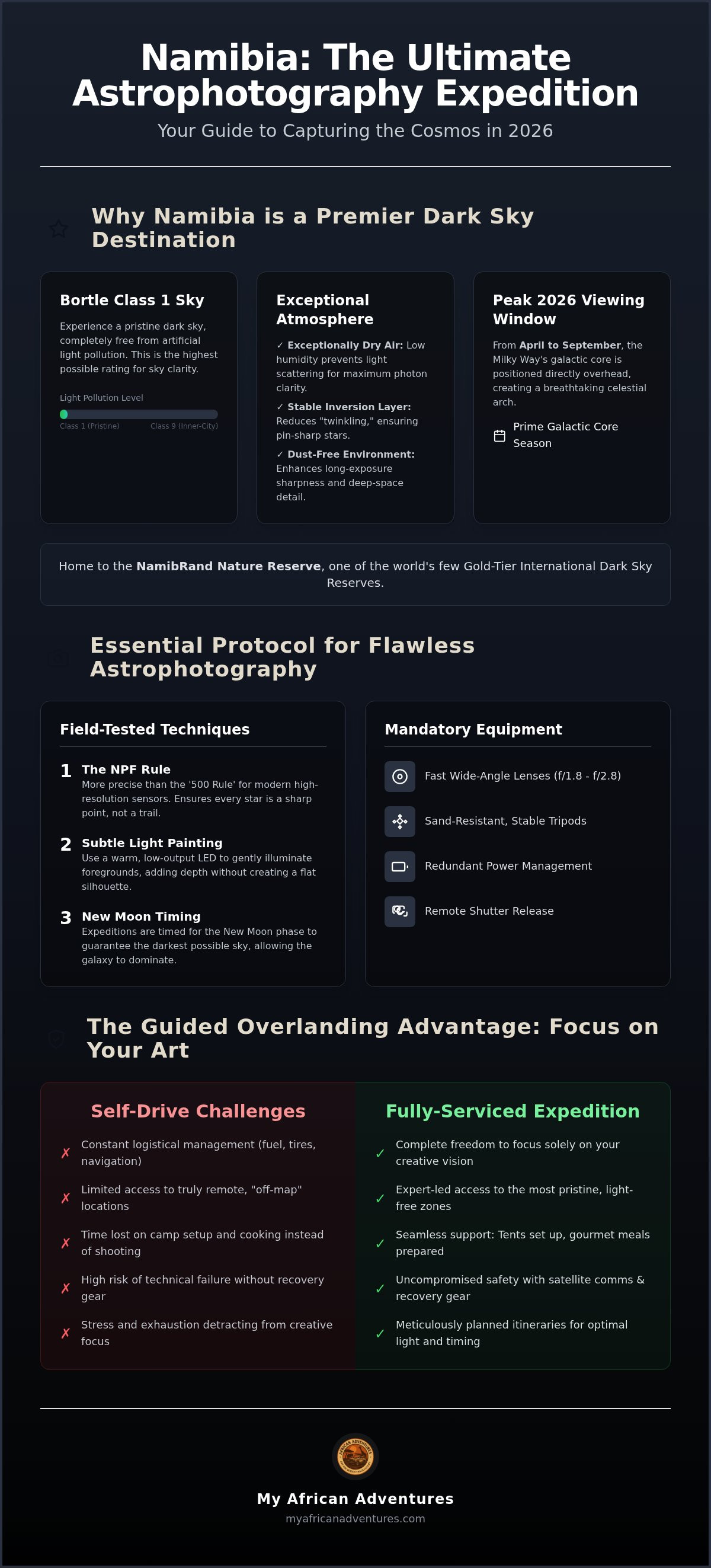
Namibia's desert interior remains one of the few places on Earth where the Bortle Scale consistently registers as Class 1. This classification represents a pristine dark sky, entirely free from the artificial glow that masks the stars in the Northern Hemisphere. The air here is exceptionally dry. Low humidity prevents the scattering of light, allowing every photon from distant galaxies to hit your sensor with absolute clarity.
The 2026 celestial calendar highlights the period from April to September as the definitive window for an astro-photography tour namibia. During these months, the galactic core of the Milky Way arches directly overhead. It creates a dense, luminous band of starlight that provides enough natural illumination to cast shadows on the desert floor. It's a transformative sight that demands both patience and precision.
The Mechanics of a Gold-Tier Dark Sky Reserve
Atmospheric stability is the secret to professional-grade results. The collision of the cold Atlantic current with the scorching desert air creates a stable inversion layer that reduces atmospheric "twinkling." This phenomenon ensures that stars remain pin-sharp points of light rather than blurred discs. The NamibRand Nature Reserve serves as a global benchmark for this clarity, holding status as one of the world's few Gold-Tier International Dark Sky Reserves.
In these remote wilderness areas, the total lack of airborne dust enhances long-exposure sharpness by removing the haze that typically softens deep-space details. This clarity is essential for capturing the Southern Cross. This iconic constellation acts as a radiant focal point for international photographers, offering a perspective of the cosmos that remains hidden from the northern half of the globe. It's a rare opportunity to document the true scale of our galaxy.
Essential Gear and Timing for a Namibian Night Sky Expedition
Success on an ultimate namibia photography expedition begins long before the sun dips below the horizon. Our 5-step preparation protocol covers sensor sterilization, redundant power management, infinite focus calibration, thermal gear checks, and tripod stability. Fast wide-angle primes with apertures of f/1.8 to f/2.8 are essential tools. These specialized lenses drink in the faint light of distant nebulae during relatively short exposures. Given the fine, invasive nature of desert dust, sand-resistant tripods and remote shutter releases are mandatory for the long-exposure work required here. These mechanical certainties allow you to capture the deep silence of the desert without technical failure.
Namibia is celebrated as one of the finest destinations on the planet for amateur astronomers. It offers a level of clarity that simply doesn't exist in more developed regions. The air is still, the horizon is wide, and the opportunities for creative expression are limitless.
Mastering the Milky Way: Techniques for the Southern Hemisphere
Avoiding star trails in the high-resolution era requires the NPF rule. This formula is far more precise than the traditional Rule of 500 for the dense Namibian star fields. It ensures every star in your frame remains a distinct, sharp point of light. When working with ancient desert flora or jagged rock formations, light painting adds a professional depth to your composition. Use a low-output, warm LED to gently brush the foreground during your exposure. This prevents the landscape from becoming a flat black silhouette against the glowing galaxy. Every successful astro-photography tour namibia is timed specifically to the 2026 New Moon. This lunar precision ensures the sky is at its darkest, allowing the galactic core to dominate your portfolio. Our premium guided tours provide the expert oversight needed to navigate these technical nuances while you remain immersed in the wild landscape.
Elevating the Experience: The Guided Overlanding Advantage
Choosing a self-drive rental for a journey this technical often results in more time spent managing tire pressures and navigation than framing shots. A premium overlanding namibia experience removes these burdens entirely. Our expert-led 4x4 expeditions grant access to "off-map" locations where light pollution is non-existent and the silence is absolute. Scientists have long documented the excellent observing conditions from Namibian soil, but reaching the most pristine pockets of the desert requires specialized equipment and local intuition. By positioning the guide as your logistical guardian, you're free to focus solely on the creative demands of your portfolio.
Seamless Logistics for the Discerning Photographer
The "fully serviced" nature of our tours ensures that the transition from a late-night shoot to rest is effortless. While you're capturing the galactic core, our team handles the professional setup of premium 4x4 rooftop tents and prepares gourmet bush meals under the stars. Safety is never a secondary thought. We utilize satellite communication and heavy-duty recovery gear to navigate the most remote terrain with confidence. This level of support is what defines an astro-photography tour namibia as a transformative journey rather than a stressful holiday.
Our best guided overlanding routes Namibia are curated specifically to prioritize light quality and location timing. It's about being in the right place at the exact moment the moon disappears. This meticulous planning ensures your 2026 expedition results in world-class imagery without the exhaustion of managing the wilderness alone.
Secure Your Vision of the Namibian Night Sky
Capturing the Southern Hemisphere's most radiant celestial displays requires more than just a camera. It demands a deep understanding of the desert's rhythm and the technical precision that only an expert-led journey can provide. From the pin-sharp clarity of a Bortle 1 sky to the rugged security of a 4x4 expedition, the elements for a world-class portfolio are now perfectly aligned. An astro-photography tour namibia isn't just a trip; it's a bridge between a standard holiday and a transformative artistic achievement. By choosing a path that prioritizes premium desert exploration and fully serviced camping logistics, you're free to focus entirely on the stars above.
Explore our Private Small-Group Namibia Expeditions for 2026 to experience our expert-led photography routes firsthand. The ancient silence of the dunes is waiting to be documented by your lens. We'll handle the wilderness so you can capture the infinite.
Frequently Asked Questions
What is the best month for an astro-photography tour in Namibia in 2026?
September is the premier month for an astro-photography tour namibia in 2026. This period offers a perfect intersection of warm daytime temperatures and cool, stable nights. While the galactic core is visible from April, September provides the darkest skies and most reliable atmospheric conditions. We align our expeditions with the New Moon phase to ensure zero lunar interference during your long exposures.
Do I need a 4x4 vehicle to reach the best stargazing spots?
A heavy duty 4x4 vehicle is mandatory for reaching the most pristine, high-elevation stargazing spots. Many of the finest Class 1 Bortle locations are situated deep within soft sand tracks or rocky terrain unreachable by standard cars. Our premium overlanding expeditions utilize specially equipped vehicles to ensure you reach these silent, off-map corners of the desert safely and in total comfort.
How do I protect my camera gear from the Namibian desert sand?
Protective measures are vital because fine desert dust can be invasive. We recommend using airtight dry bags for storage and avoiding lens changes while exposed to the wind. Utilizing a high quality UV filter protects your front element from micro-abrasions caused by airborne grit. Our guides act as logistical guardians, providing sheltered environments for gear maintenance and ensuring your sensor remains sterile throughout the journey.
Is an astro-photography tour suitable for beginners?
Beginners are welcome on an astro-photography tour namibia as our expert guides provide comprehensive technical support. You don't need to be a seasoned professional to capture stunning results; you just need a curiosity for the cosmos and the right equipment. We handle the complex navigation and Southern Hemisphere celestial movements, allowing you to learn the art of long exposure in a supportive, high-end environment.