


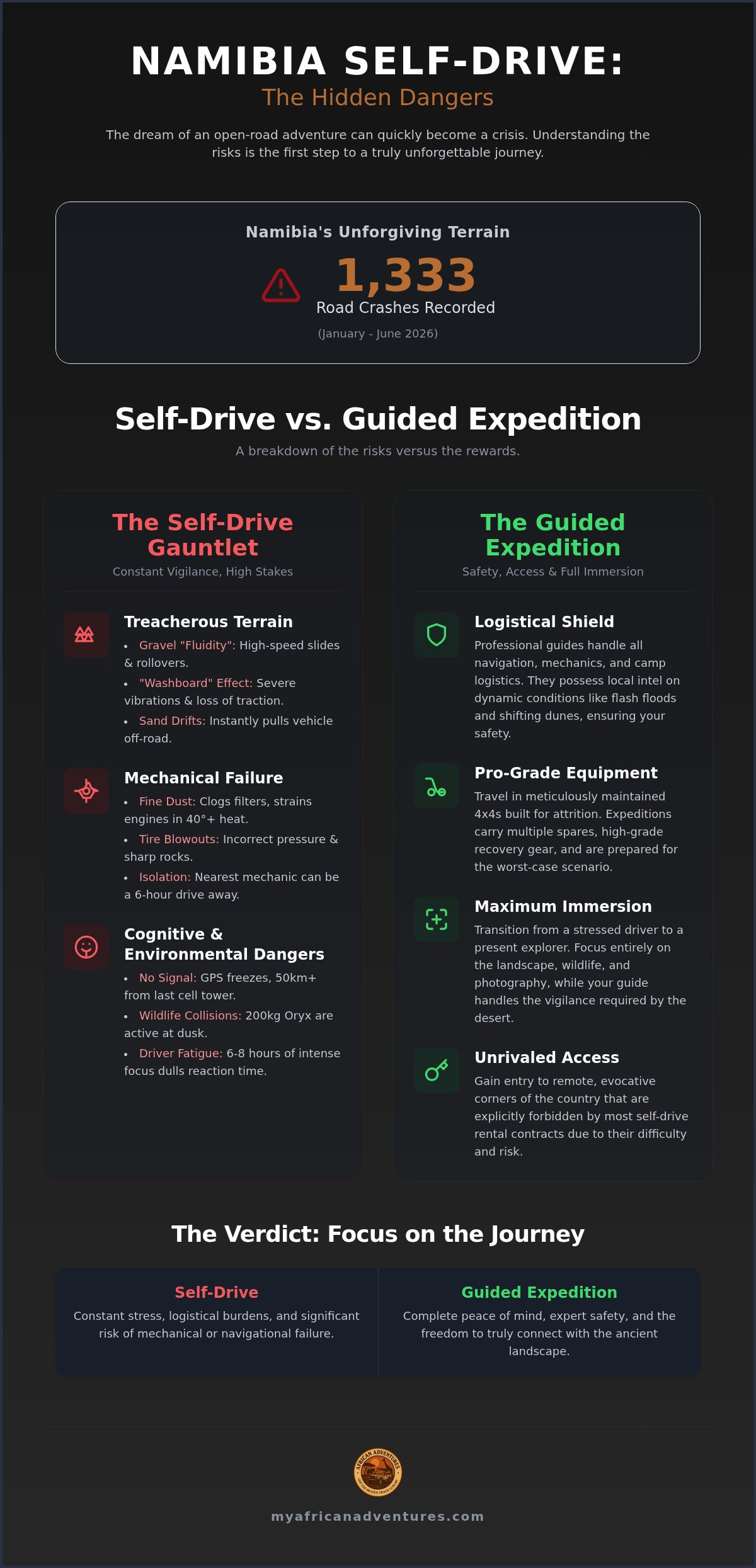
The vast, golden silence of the Namib Desert is breathtaking, but the latest data tells a sharper story: between January and June 2026 alone, Namibia recorded 1,333 road crashes across its unforgiving terrain. While the dream of an open-road adventure is alluring, the dangers of self-driving in Namibia are often hidden beneath the shifting sands and corrugated gravel. It's easy to underestimate the sheer isolation of the Skeleton Coast or the technical skill required to prevent a rollover on a deceptively smooth-looking salt road. When the horizon stretches for hundreds of miles without a cell tower in sight, a simple navigational error can quickly become a genuine crisis.
You deserve to lose yourself in the ancient landscape without the constant anxiety of a shredded tire or a lost signal. We know that a true African journey should be about connection and transformation, not the exhausting burden of logistics and mechanical stress. This article reveals the hidden risks of navigating these treacherous landscapes alone and explains why a guided premium expedition is your ultimate safety feature. We'll explore how an expert guardian handles the complexities of the desert, allowing you to enjoy maximum immersion and total peace of mind for your companions.
The Treacherous Physics of Namibia’s Gravel Roads
The C-roads and D-roads that weave through the desert appear as shimmering ribbons of freedom. Most of Namibia's road network consists of these unpaved surfaces, ranging from hard-packed salt to loose, sharp stones. It's here that the dangers of self-driving in Namibia become most apparent. At high speeds, gravel behaves like a fluid. A sudden steering correction that would be minor on tarmac becomes a violent, uncontrolled slide. Centrifugal force takes over; the vehicle's high center of gravity does the rest. Rollovers aren't just a possibility. They're a frequent reality for those who mistake an empty horizon for a safe racetrack.
Then there is the "washboard" effect. Corrugations are rhythmic ridges that form on the road surface, vibrating through the chassis with bone-shaking intensity. If you drive too slow, the car feels like it's falling apart; if you drive too fast, your tires lose contact with the ground entirely. This loss of traction is compounded by the "sand-drift" trap. Soft sand often accumulates at the edges of tracks, waiting to pull a front wheel into the shoulder. Once the sand grabs you, the vehicle yanks toward the ditch. The dangers of self-driving in Namibia are amplified when an inexperienced driver overcorrects in panic.
Managing this terrain is a constant science of tire pressure. You might need 1.8 bar for a rocky mountain pass but must drop to 1.2 bar for the deep dunes of Sossusvlei. Most self-drivers ignore these adjustments, leading to overheating rubber and catastrophic blowouts in the midday heat. Our expert guides monitor these variables hourly, ensuring the vehicle remains a vessel of comfort rather than a liability.
Mechanical Stress and the Reality of Breakdowns
The desert is a relentless machine-eater. Fine calcrete dust finds its way into every seal, clogging air filters and straining engines already battling 40-degree heat. This isn't just about a check-engine light. It's about a total mechanical failure in a place where the nearest mechanic is a six-hour drive away. Our expeditions use vehicles prepared to withstand this attrition, maintained by professionals who know exactly where the desert strikes first.
The double-spare necessity
One flat tire is a nuisance. Two is a survival situation. Sharp volcanic rocks in the Damaraland region can slice through a sidewall in seconds. If you only carry one spare, you're effectively stranded the moment the second tire fails. We carry multiple spares and high-grade recovery gear, ensuring that a sharp rock remains a story for the campfire rather than a call for a rescue helicopter.
Beyond the Map: The Invisible Risks of Independent Travel
The vast, silent expanses of the Pro-Namib are hauntingly beautiful until you realize your GPS has frozen and the last bar of cell signal vanished fifty kilometers ago. This psychological weight is one of the most overlooked dangers of self-driving in Namibia. When you're the one responsible for the safety of your family in a region where medical facilities are sparse and emergency response can take hours, the "adventure" can quickly transform into an ordeal. You spend your day white-knuckling the wheel, eyes locked on the track for sharp stones, while the desert-adapted elephants you came to see pass by unnoticed in the periphery.
Nature here is dynamic and often deceptive. A dry riverbed that looked stable an hour ago can become a churning flash flood after a distant, unseen storm. Shifting dunes can erase a known track in a single afternoon. Without the local intel of a seasoned guardian, you're essentially gambling with the terrain. This risk peaks during the "golden hour." While photographers crave this light, it's also when kudu and oryx are most active. Striking a 200kg oryx at dusk is a leading cause of the road fatalities that increased by 13% in the 2025/2026 period. Driving after dark is strongly discouraged for this reason, yet many self-drivers find themselves racing against a setting sun because they underestimated the travel time between camps.
The Mental Cost of Constant Vigilance
Driving for six to eight hours across sun-bleached plains induces a specific type of cognitive fatigue. Your decision-making slows. Your reaction times dull. This mental exhaustion is why many independent travelers find themselves "missing the shot." Instead of capturing the perfect light, they're preoccupied with finding the next fuel stop or worrying about a strange rattle in the undercarriage. On a Namibia photography expedition, we remove this burden entirely. You're free to be an artist and an explorer while we handle the high-stakes vigilance required by the desert.
If you seek a journey where the only thing you need to focus on is the majesty of the landscape, consider joining one of our Private Small-Group Namibia Expeditions.
Guided Premium Overlanding: Safety Through Expert Curation
True freedom in the desert isn't found in the driver's seat. It's found in the moment you realize you don't have to look at the road at all. While the allure of the open road is strong, the transition from driver to passenger allows for a profound shift in perspective. You move from a state of high-alert vigilance to one of deep, sensory immersion. The professional guide acts as a logistical shield, absorbing the grit of the journey. Whether it's a tire change in the midday heat or navigating a complex camp setup under the stars, these tasks are handled with quiet efficiency. You are left to focus on the narrative of the landscape, the way the light hits the dunes, and the stories written in the sand.
There is also the matter of access. Most rental contracts for self-drivers come with a long list of forbidden zones, effectively barring you from the most evocative and remote corners of the country. These restrictions exist precisely because the dangers of self-driving in Namibia are too high for standard insurance to cover in regions like the Kaokoveld or the deep dunes of the Skeleton Coast. Our expeditions bypass these limitations. With a seasoned professional at the wheel, you can safely reach the hidden valleys and ancient desert-adapted wildlife habitats that remain off-limits to the unguided traveler. Choosing premium overlanding in Namibia is the more refined choice, ensuring your journey is defined by discovery rather than mechanical distress.
Why a Private Expedition Outperforms a Self-Drive Rental
A static map or a GPS unit cannot account for the fluid nature of the African bush. Real-time local knowledge is the only currency that matters when a seasonal river suddenly floods or a known track is erased by a sandstorm. Our guides are in constant contact with local networks, receiving updates on road closures and recent wildlife movements that no app can provide. This intelligence allows us to pivot the itinerary instantly, keeping you safe while maximizing your sightings. Our expert-led overlanding routes prioritize your safety without sacrificing the rugged, authentic feel of a true African exploration. We handle the complexities of the terrain so that you can return home with memories of wonder, not stories of survival.
Embrace the Wild with Absolute Certainty
The desert is a place for quiet reflection and profound discovery; it shouldn't be a test of mechanical survival. We've explored the treacherous physics of gravel and the invisible risks of isolation, but the final takeaway is clear. Your focus belongs on the shimmering horizon, not the tire pressure gauge. By acknowledging the dangers of self-driving in Namibia, you're choosing to elevate your journey from a high-stakes commute to a curated masterpiece of exploration. You don't have to sacrifice rugged adventure for refined comfort when a seasoned guardian handles the complexity on your behalf.
Our expeditions provide more than just a safety net. We offer a gateway to the most evocative, remote corners of the continent through expert-led 4x4 logistics and fully serviced camping experiences that allow you to truly disconnect. Whether you are chasing the perfect light on our photography-focused itineraries or sharing a silent sunset with your family, we ensure every detail is seamless. The wild is waiting, and it's best experienced when you are free to simply be present in the moment.
Explore our premium guided Namibia expeditions for a stress-free adventure and begin your transformation in the heart of the dunes.
Common Questions Regarding Namibian Travel Safety
Is it safe to drive at night in Namibia?
Driving after dark is strictly discouraged and represents one of the most significant dangers of self-driving in Namibia. The risk of encountering large wildlife like kudu or oryx on unlit roads is exceptionally high, and these collisions are often catastrophic. Visibility is poor, and the lack of artificial lighting makes it nearly impossible to spot a sudden change in road surface or a deep sand drift before it's too late.
What is the most common cause of accidents for tourists in Namibia?
Excessive speed on gravel roads is the leading cause of tourist accidents and vehicle rollovers. Many drivers fail to respect the shifting nature of unpaved surfaces, which lack the predictable grip of tarmac. With 1,333 road crashes recorded in the first half of 2026, it's clear that underestimating the physics of the terrain leads to tragic results for those unfamiliar with the landscape's hidden hazards.
Do I need a 4x4 for a self-drive trip, or is a 2WD enough?
A high-clearance 4x4 vehicle is essential for navigating the majority of the country safely and effectively. While some main arteries are paved, the most iconic routes involve deep corrugation and soft sand that would quickly overwhelm a standard 2WD car. A robust 4x4 provides the necessary traction and stability to handle the diverse topography of the Namib and Damaraland regions without risking mechanical failure.
What happens if I break down in a remote part of the desert?
Breaking down in a remote desert area can quickly escalate into a survival situation if you're not properly equipped with water and communication tools. Mobile phone coverage is unreliable or non-existent in the deep desert, meaning you can't simply call for a tow truck. This isolation is why we emphasize the importance of expert guardians who carry satellite communications and specialized recovery gear to manage the dangers of self-driving in Namibia with professional ease.