


Imagine standing in a sun-bleached riverbed where the silence is so profound it feels physical, only to realize that a six-ton giant is moving with ghostly grace just behind a stand of ancient ana trees. You likely worry that your presence might disrupt these fragile herds or that the vastness of the Namib will simply hide its secrets from you. It's a valid concern in an era of intrusive tourism. At My African Adventures, we understand that you seek a meaningful connection through desert adapted elephant tracking rather than a fleeting, disruptive glance.
This article promises to reveal the sophisticated techniques and deep ethical considerations behind these premium 2026 expeditions. We will explore how expert guides interpret the landscape's subtle cues and discuss the latest conservation protocols protecting these precious, unique populations. You'll gain a masterclass in elephant behavior while we handle every logistical complexity of the wild.
The Psychology of Survival: What Defines Desert Adapted Elephant Tracking
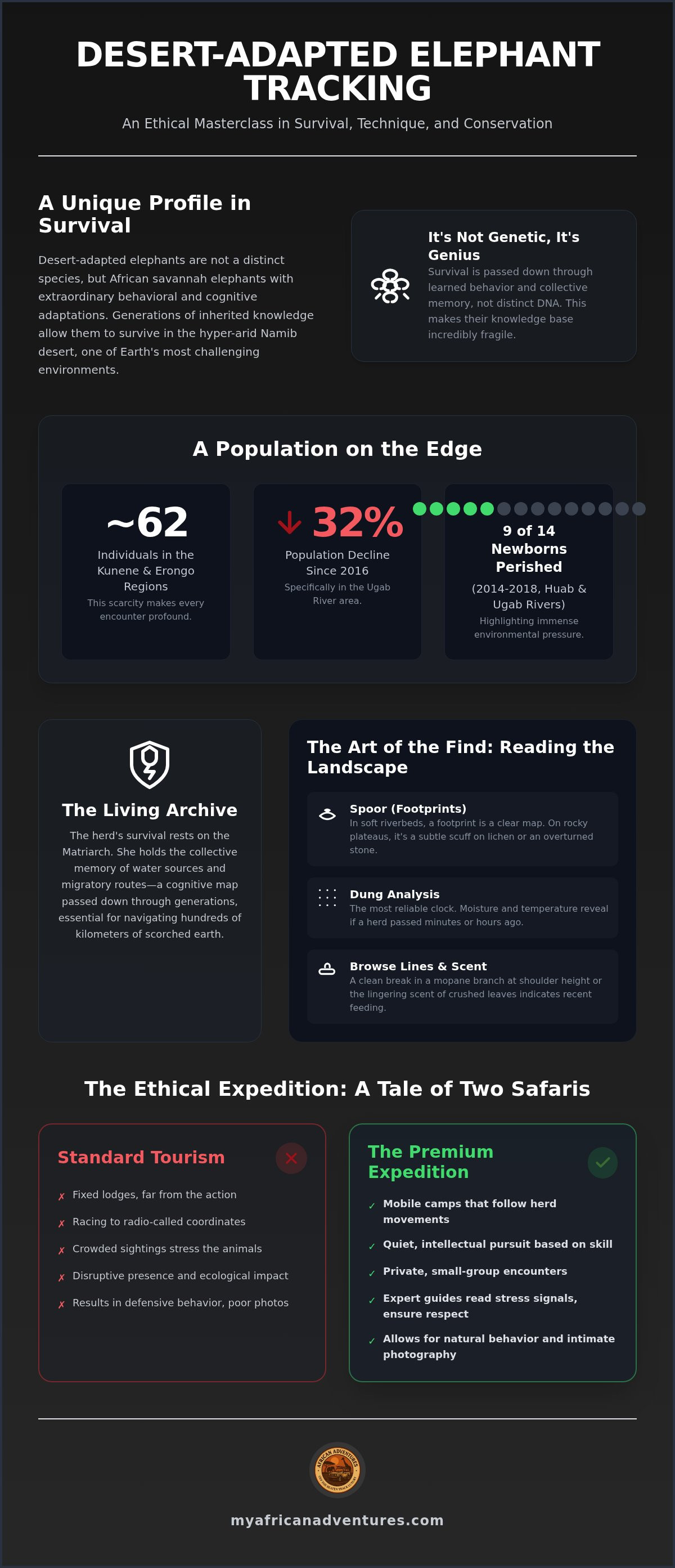
Desert-adapted elephants are not a distinct biological species, yet they possess a psychological profile unlike any other mammal on earth. They're African savannah elephants that have refined their behavior over generations to survive the hyper-arid stretches of the Namib. Current 2026 data reveals a sobering reality for these herds. The resident population in the southern Kunene and northern Erongo regions is approximately 62 individuals. In the Ugab River area specifically, numbers have dwindled by 32% since 2016. This scarcity transforms every sighting into a profound, high-stakes encounter.
Successful desert adapted elephant tracking requires a shift in mindset. Unlike standard safaris where vehicles might race toward radio-called coordinates, this is a quiet, intellectual pursuit. It's an exercise in patience. We look for the subtle press of a foot in the dust or the specific way a mopane branch has been stripped. You'll learn to read the landscape like a historical text, understanding that every mark tells a story of a herd's movement toward survival. The pace is slow. It's intentional.
Cognitive Adaptations and Herd Knowledge
The survival of the herd rests entirely on the shoulders of the matriarch. These female leaders act as living archives, holding the collective memory of water seeps and food sources that may only be viable once every decade. They lead their families across hundreds of kilometers of scorched earth with surgical precision. Ephemeral riverbed navigation is the cornerstone of desert survival, acting as a biological compass that guides herds through the shifting sands of the Namib. This inherited wisdom is fragile. Between 2014 and 2018, 9 out of 14 newborn calves perished in the Huab and Ugab Rivers, highlighting the immense pressure these cognitive maps must overcome. During your desert adapted elephant tracking expedition, you'll witness the results of this generational knowledge as herds move with purpose toward hidden resources.
The Art of the Find: Techniques for Tracking in Arid Landscapes
Successful desert adapted elephant tracking starts with the spoor. In the soft riverbeds of the Namib, a footprint is a clear, topographical map of an elephant's journey. On rocky plateaus, the signs are more subtle. We look for the sheen of a recently overturned stone or a scuff mark on sun-baked lichen. While modern elephant tracking techniques utilize satellite imagery to monitor broad movements, the final mile always belongs to the ground-level expert. It's an exercise in sensory acuity.
We analyze browse lines in the mopane trees, looking for the scent of crushed leaves lingering in the air. A clean break in a branch at shoulder height indicates recent activity. Fresh dung remains the most reliable clock. Its moisture level and internal temperature tell us if the herd passed hours ago or just minutes before. We also monitor thermal patterns. As the desert heats, wind swirls through the canyons. We use this knowledge to approach from downwind, ensuring the elephants stay undisturbed by our presence.
Reading the Language of the Desert
Distinguishing between track types is essential for managing expectations. Traveling tracks are linear, suggesting a herd moving between distant water points. Feeding tracks are meandering, showing a relaxed group browsing on acacia pods. Our guided 4x4 tour damaraland namibia uses low-pressure tires to traverse soft sand without scarring the ecosystem. This ensures your desert adapted elephant tracking remains intimate and ecologically sound. If you're ready for a deeper connection, our fully serviced 4x4 camping adventures provide the perfect balance of ruggedness and refined expertise.
The Premium Expedition: Why Expert-Led Logistics Matter
Choosing premium overlanding namibia is about more than luxury; it's about mobility. Desert herds don't follow a schedule. They move with the whispers of the wind and the promise of distant rain. A fixed lodge often leaves you far from the action, but a mobile expedition allows us to stay reactive to herd movements. Authentic desert adapted elephant tracking requires a guide who understands the ethics of the encounter. Our professional guides act as trusted guardians, reading subtle stress signals like ear-fanning or trunk-swinging to ensure we always maintain a respectful distance.
The experience is a seamless blend of ruggedness and sophistication. You'll spend your days exploring untamed terrain, knowing that a fully serviced camp awaits you at sunset. We handle the logistical complexities of the Namib so you can focus on the connection to the landscape. It's high-end service without the hassle, where gourmet meals and comfortable rooftop tents meet the raw beauty of the wild. This level of curation ensures your safety while providing an intimate window into one of the most remote environments on earth.
Exclusivity and Ethical Wildlife Photography
Capturing the immense scale of an elephant against the vast, orange dunes requires patience and precision. On our ultimate namibia photography expedition, we prioritize the light and the composition that only a private setting can provide. Mass-market tours often crowd the animals, leading to defensive behavior and poor shots. In contrast, our guided namibia tours focus on private, small-group settings. This silence allows for natural behavior during your desert adapted elephant tracking journey, giving you the chance to photograph a calf playing or a bull feeding in total peace. It's an intimate encounter that respects the animal's space while delivering world-class imagery.
Begin Your Masterclass in the Namib
The pursuit of these resilient giants is more than a safari; it's a profound lesson in patience and environmental stewardship. You now understand that desert adapted elephant tracking requires a sophisticated blend of traditional spoor reading and modern ethical restraint. By prioritizing private, small-group settings, you ensure that these fragile herds remain undisturbed while you capture their majesty through your lens. Expert-led 4x4 expeditions bridge the gap between the raw, untamed desert and the refined comfort you deserve. Our fully serviced premium camping and photography-focused itineraries allow you to focus entirely on the transformative power of the landscape. It's time to step beyond the ordinary and witness the enduring spirit of Namibia's wild. Book your private desert elephant expedition with My African Adventures today and secure your place in this exclusive 2026 journey. The desert is waiting to share its secrets with you.
Frequently Asked Questions
Are desert-adapted elephants a different species from savannah elephants?
No, desert-adapted elephants are biologically the same species as the African savannah elephant. They've simply developed unique behavioral traits and physical nuances to survive in Namibia's arid Kunene and Erongo regions. You'll notice they often have slightly longer legs and smaller tusks. These adaptations help them traverse vast distances between water points without the bulk seen in their savannah cousins.
What is the best time of year for desert adapted elephant tracking?
The dry winter months from June to October offer the highest success rates for desert adapted elephant tracking. During this period, herds congregate in ephemeral riverbeds where water and vegetation are most accessible. This concentration makes sightings far more predictable. The cooler temperatures also ensure that long days spent in the 4x4 remain comfortable and inspiring for every traveler.
How do guides find elephants in such a vast desert landscape?
Finding these giants requires a masterclass in reading environmental cues. Our guides don't rely on luck; they interpret fresh dung, broken branches, and the specific press of a foot in the dust. They also use topographical knowledge to predict movement based on wind direction and thermal patterns. It's a methodical, quiet process that turns the vast Namib into a readable map.
Is it safe to track desert elephants on foot?
Tracking is primarily conducted from the safety of a 4x4 vehicle to ensure both guest safety and minimal herd disruption. These elephants are wild and can be protective, especially with the current high calf mortality rates in the region. Using a vehicle acts as a mobile sanctuary. It allows for intimate, ethical viewing without triggering the animal's natural stress or defensive responses.