


The iconic red dunes of Sossusvlei won't yield a single lion, and a standard national park loop will never bring you face-to-face with one traversing a barren canyon. If you're wondering how to see desert lions in Namibia, the reality requires dispelling comfortable safari myths. It's completely natural to worry about spending days in hyper-arid gravel plains without a sighting, or worse, unintentionally disturbing an endangered predator just to get a photograph.
With roughly 73 of these resilient predators surviving across the harsh Kunene Region, ethical tracking is a deliberate art grounded in deep desert navigation. In this guide, you'll discover where these apex survivors actually live, how community-led conservation protects them, and the specialized expedition strategies that unlock unforgettable, photography-ready encounters in 2026.
The Desert Lion Myth: Why They Aren't Where You Think
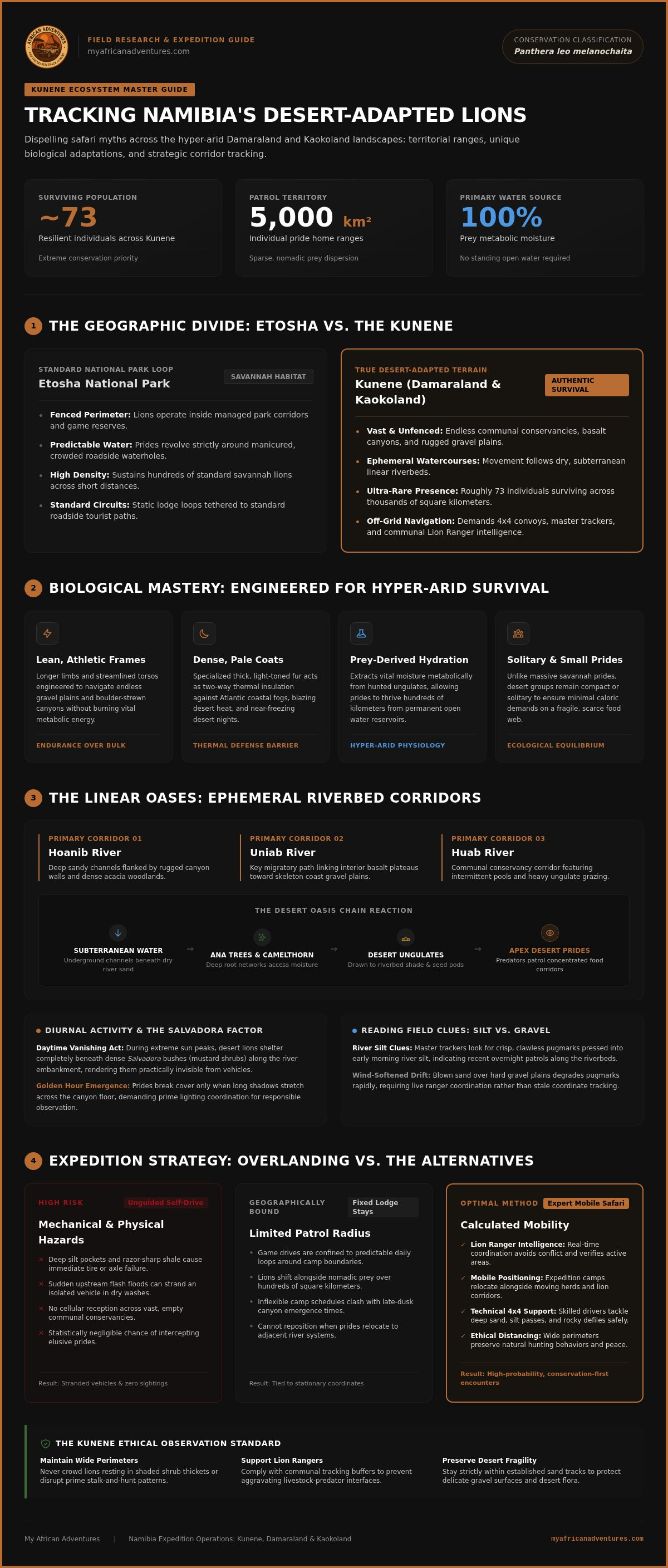
A frequent mistake travelers make when researching how to see desert lions in Namibia is assuming these apex predators roam behind the fences of Etosha National Park. While Etosha sustains hundreds of savannah lions around crowded waterholes, true desert-adapted lions belong exclusively to the hyper-arid Kunene Region across Damaraland and Kaokoland. Biologically classified under Panthera leo melanochaita, desert lions are a population that has mastered survival in one of Earth's most unforgiving landscapes, drawing metabolic moisture almost entirely from their prey while patrolling vast territories stretching up to 5,000 square kilometers.
Sightings here are an extraordinary privilege, not a standard itinerary line item. With the regional population standing at roughly 73 individuals, locating them demands patience, profound wilderness respect, and specialized desert navigation.
Etosha vs. The Kunene: Understanding the Geographic Divide
Understanding this stark divide changes everything about how to see desert lions in Namibia. In Etosha, pride movements revolve around manicured roadside water sources. In the vast, unfenced northwest, tracking requires following dry ephemeral riverbeds flanked by basalt mountains. A dedicated guided 4x4 tour damaraland namibia routes through these rugged communal conservancies rather than tourist corridors.
Visually, these desert survivors reflect their severe environment:
- Leaner, athletic frames: Longer limbs built to traverse endless gravel plains and boulder-strewn canyons without burning excess energy.
- Denser, pale coats: Specialized fur providing thermal defense against coastal fog and freezing desert nights.
- Solitary habits: Small pride structures adapted to sparse prey distributions across fragile desert ecosystems.
Strategic Tracking: How to Ethically Locate Lions in the Arid Wilds
Mastering how to see desert lions in Namibia comes down to understanding linear oases. Across hyper-arid terrain, life congregates along the dry corridors of the Hoanib, Uniab, and Huab riverbeds. Subterranean water supports stands of ana trees and camelthorn, which draw desert ungulates and keep apex predators close. Tracking along these sandy watercourses offers the greatest likelihood of intercepting pride movement.
Ethical tracking demands uncompromising discipline. Seasoned trackers maintain a wide perimeter to avoid disturbing hunting patterns or aggravating human-wildlife conflict near conservancy borders. For photographers, patience is your best tool. During peak daytime heat, desert lions often vanish for hours beneath dense Salvadora bushes, emerging only when long shadows sweep across the canyon floor.
The Vital Role of Expert Guides and Local Intelligence
Static coordinates won't help you in shifting sand. Real tracking depends on live intelligence shared by communal Lion Rangers, who work to prevent livestock conflicts while safeguarding pride territories. Master trackers serve as trusted guardians of the wilderness, reading subtle cues in the environment: crisp clawless pugmarks pressed into morning river silt versus wind-softened tracks across hard gravel plains.
Balancing tracking stamina with prime lighting is a delicate science. Joining the ultimate namibia photography expedition allows you to maneuver into golden hour positions without stressing the animals. If you're considering how to see desert lions in Namibia, exploring with expert-led private expeditions ensures your presence supports conservation while delivering exceptional, responsible sightings.
The Necessity of Expert-Led Expeditions for Rare Wildlife Encounters
Attempting an unguided self-drive through hyper-arid riverbeds often leads to mechanical distress and zero sightings. Deep silt, razor-sharp shale, and sudden upstream flash floods can quickly strand an isolated vehicle far beyond cellular reach. When discerning travelers ask how to see desert lions in Namibia, the answer lies in calculated mobility. Embracing premium overlanding namibia bridges the gap between rugged, boundary-pushing exploration and the refined comfort of a fully serviced expedition.
Why Premium Overlanding Outperforms Static Lodges
Fixed lodges confine game drives to predictable loops around camp boundaries. Desert lions, however, patrol enormous ranges that shift alongside nomadic prey. Mobile expeditions adapt to these movements, positioning comfortable camps near active wildlife corridors rather than tethering you to a stationary base.
Entering remote lion territory with a private, expert-led 4x4 convoy delivers logistical certainty in an unforgiving landscape. Dedicated routes, such as a curated 10-day guided tour namibia, maximize your time within high-probability tracking zones. With our trusted guides handling treacherous deep-sand maneuvers and technical river passes, your attention remains where it belongs: scanning red canyon rims, perfecting compositions through your lens, and absorbing the silence. It is the definitive approach to how to see desert lions in Namibia, transforming an elusive tracking ambition into a life-changing wilderness encounter.
Turn the Elusive Tracking Dream into Wilderness Reality
Encountering desert-adapted lions requires trading crowded tourist circuits for genuine wilderness immersion. Understanding how to see desert lions in Namibia means respecting the fragile life of the Kunene's dry river corridors, honoring communal conservation efforts, and moving in rhythm with nomadic prides across unpaved frontiers.
Our expert 4x4 guides navigate this rugged terrain with seasoned confidence, while photography-focused itineraries position you for extraordinary frames in gentle golden light. After rewarding days on the spoor, retreat to the ease of premium serviced camping beneath an ocean of stars. The quiet beauty of the desert is calling. Book Your Private Namibia Lion Expedition and experience an authentic journey that will shape how you view the wild forever.
Frequently Asked Questions
Are desert lions a different species than African lions?
No, desert lions are biologically classified as Southern African lions, or Panthera leo melanochaita. They don't belong to a distinct subspecies. Instead, their unique traits are ecological and behavioral adaptations passed down through generations. These learned survival skills allow them to navigate massive arid territories, endure extreme temperature swings, and draw metabolic moisture almost entirely from their prey.
Is it safe to see desert lions while camping in Namibia?
Yes, provided you travel on fully serviced expeditions led by experienced guides. Certified wilderness trackers follow strict safety protocols, reading predator movements and maintaining secure campsites. Elevated rooftop tents keep guests well above ground level. If you're exploring how to see desert lions in Namibia, venturing unguided is hazardous, but a professionally managed small-group expedition ensures total safety and comfort.
What is the best time of year to see desert lions?
The dry winter months from June through October offer the highest probability of sightings. As seasonal surface water disappears across the Kunene Region, desert game gathers along dry ephemeral river systems, drawing prides into these linear oases. Cooler daytime temperatures also encourage predator movement while completely avoiding the summer rain cycle that brings sudden, dangerous flash floods.
Can I find desert lions in Etosha National Park?
No, true desert-adapted lions do not live inside Etosha National Park. Etosha supports a thriving population of savannah lions that gather near reliable waterholes within a fenced sanctuary. Anyone researching how to see desert lions in Namibia must journey into the unfenced, remote northwest Kunene Region, where these resilient cats roam wild across barren gravel plains and rugged canyons.